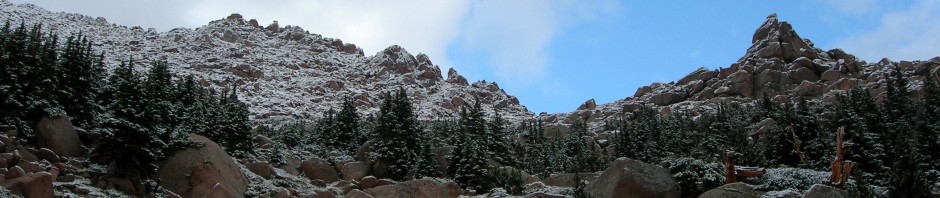

Pikes Peak Ascent and Marathon Running Race - August 15-17, 2008
"It will be a good test of our equipment..."

A now infamous pre trip quote...
Don and I are sitting in the Pikes Peak Cog
Railroad car with our heavy packs between our legs counting the clicks from the
cog track as we descend off
By the time I check on my gear on my first day back, most of my gear will be dry. When I touch it to pack it back up for the next adventure, the familiar wetness, cold, and smell I lived with for three days will be gone. It is a race to record these memories for my old age before that gear dries…
This
adventure started out innocently enough in May 08 with Don suggesting I work the
Pikes Peak Ascent and
Marathon as communications support for the Pikes
Peak Amateur Radio Emergency service with him.
Back
in May of this year, Don had suggested we man a more remote outpost and camp out
the whole weekend at A Frame at 11,950’ at tree line on the east face of
As June and July passed, Colorado experienced its normal weather pattern, a dry start to the summer followed by monsoon season at the beginning of August.
In
my line of work this is called a CLUE! While we all agree weather can make any
adventure more exciting, I had decided in 2005 that I would no longer plan to go
out in epic weather, thinking I was maturing out of that stage where I would
“plan” to go out in “known” bad weather. It had gotten me into
“trouble” in the past.
We
met at the Cog Railway
Station, made last minute changes to my pack’s contents
(took out the bivy sack, stuffed in the tent (mistake)), and hopped on the train to the
summit with the tourists. As we
ascended on the train listening to the conductor give the tourists the highpoints
of the sights and vistas it was obvious there would not be much to see as
we reached tree line and entered the clouds. Visibility was 100 feet and the
temperature dropped. We were happy these were “comp” tickets (free) for the
race workers as there was nothing to see. We had earlier dropped off about 10
aid workers at the Mountain View
station who were manning the station at Barr Camp.
But sticking to OUR plan, we stepped out of the train car, and put our backs to the wind to find the trailhead on the other side of the tracks to start down the east face. Don led down the “16 golden steps” in nasty conditions as we worked our way down the face as we passed the “Cirque”. Waves of moisture alternating between sleet, snow and hail pummeled us all the way down. About an hour later, we encountered our first small bushes knowing we were reaching tree line. Reaching tree line, we saw the A Frame Shelter and traversed over to it. There we met Dave and Paul, the two aid station leaders we would be supporting. They were busy heating some spaghetti over a sterno stove and not making much progress.
At "A frame" a few
minutes after our arrival
We
clambered into A frame shelter to get out of the wind and rain and catch our
breath. Don fired up his denatured
alcohol stove and after watching the poor sterno make no headway at nearly
12,000 feet. I fired up my MSR
Whisperlite to put a roaring torch under their
pan of water containing a bag of cold spaghetti. In short time the water was
boiling, their spaghetti was getting hot and their plastic bag was breaking.
But they dealt with it fine and christened me “Blowtorch Bob”. In the
meantime, Don was watching his "hobby" stove slowly warm his water.
Saturday, August
16th, 2008
Opening our eyes at 5:15 am, we realize the radio “net” would be beginning shortly as the caravan of workers que’d up at the entrance to the Pikes Peak Highway to drive to the summit to support the race. We called in with a weather report; 30 degrees, light rain, heavy fog. The weather outside of the shelter was not much better…. :-)
Making breakfast it was apparent that we needed to dress for warmth and to stay dry. Usually when I am outdoors in winter conditions, I am moving and able to generate heat; this would not be the case today as we manned the checkpoint. Heavy weight clothing and fleece under full Gore-Tex shells was the order of the day. We listened to the start of the race over the radio, knowing it would be about 1.5 hours before the runners reached our location. When I heard the first runner had passed Barr Camp, I left the shelter and headed over to the checkpoint.
Amy, braving the
miserable conditions to render aid
The
weather worsened immediately, but the aid workers continued their difficult task
of setting up water, Gatorade, and snacks in ever increasingly sleet, snow and
rain. The workers, led by Dave and Paul, actually ran garden hoses from the
stream and then pumped the water through filters into garbage bagged lined trash
cans where they held the water. I was impressed with every volunteer worker I
met as they all worked VERY hard under tough conditions.
Don and I set up at the start of the aid station to call in the numbers
of the first three male and female runners to race control. We also reported any
“turn arounds” so every runner could be accounted for by the race director.
Conditions continued to deteriorate with heavy snow and sleet and the
occasional lightening strike and accompanying thunder.
By 9:30 when the strongest runners started to reach our checkpoint (2.5 hours into the race), the conditions were very tough. In my opinion, 80%+ of all of the runners reaching us were already in various stages of hypothermia. El Paso County Search and Rescue were present and Brian, who was also an EMT, looked over many runners. Although Don and I are both members of Teller County Search and Rescue team, that was not our role today unless there was an overwhelming emergency. We were there to report the race details to the race director, via our amateur radios.

Between
9:30 and 10:00am, the weather reached its absolute worst just as the main body of
runners was reaching tree line. Many
people voluntarily turned around knowing that going above tree line was
potentially life threatening While
the aid workers supplied encouragement, the El PASO SAR workers and Don and I
were telling each runner, “if you
cannot maintain your core body temperature at this point, turn around now; do
not go above tree line. Serious weather is imminent and potentially life
threatening. It is 25 degrees, blowing snow and icy on the summit”
The race director asked for a weather report from the summit and our station at about 10:05am and based upon the facts moved up the turn around time at A Frame from 11:15/1145 (two different waves) to 10:15. Within 5 minutes the race was over as mandated by the director and all runners below A frame had to turn around. Perhaps some 500 runners had not made it to our location yet and would be turned around. All were soaked, cold, and tired and now faced a 10 mile descent rather than the final 3 mile ascent to the summit. Their day went from 13 miles to 20 miles as the raced stopped.

Conditions at top above tree line at 14,000' when the race was stopped ....photo by Chuck
And the medical area fills up...photo by Chuck

Some
cried, some argued, some thanked us for turning them around, but all in all it
was an emotional time for exhausted runners as they reached our location. Even
though people who had already started to descend told them the race was closed,
they continued up to our station for three reasons; 1) They needed food and
water, 2) they wanted to hear it with their own ears and beg for a chance to
continue up, or 3) they just wanted to make A Frame for their goal.
I’ll
take a short detour here to give my views on runners in the mountains. I’ll
probably lose all runner readers from my website, but I learned a lot about them
on this weekend and now I know how they think. They see the 13 miles to the
summit as time splits, mileage, and how long it will take them to run from point
“A” to point “B”. I
understand that completely as I am also driven in that mode often in several
different personal pursuits. But
what causes me to pause is that “some”
runners think they can out run weather and other hazards or they are immune from
getting hurt on big mountains. The people who were begging us to continue up on
Saturday were already hypothermic and did not even know it.
Their hands could not function as I helped them put on jackets or
gloves.
At
about 1:00pm, the runners stopped arriving and the aid workers packed up to
depart for the day, electing to hike a long way down to a dry bed and cold beer.
Dave and Paul had enough of the cold and wet and also departed, leaving
their water logged tent to be packed out on Sunday.
There had been a second tent set up in the meadow by A Frame when we
arrived and although Don checked it for a body, he had found it empty.
At 11,950’ on the east side of Pike Peak Don, Mark and I lay in our sleeping bags for any chance at warmth as we watched sleet, rain, snow, and grapple out the open side of “A Frame” as cloud after cloud rolled UP the mountain and right INTO our shelter. Everything was wet and everything was cold. We were in the fog, and our minds were in fog. We just burrowed deeper into our bags which was our cocoon for the next 16 hours. Time passed slowly for the next 16 hours…

A
long 16 hours
The
only bright spot was listening to Mike Phelps win his 8th gold medal on the
radio. We all cheered and then put our heads back in our bags.
Right before that broadcast I did step out of the A frame to filter some
water and saw the clouds have cleared briefly and there it was…the summit in
all its glory. I shouted to Mark and Don to come join me but neither
stirred...back to my bag.
Sunday,
Aug 17th, 2008
I spent a restless night on a thermarest pad with a slow leak that forced me to inflate it once an hour or when I woke up in pain from laying on the wood floor. I opened my left eye about 4:00 and noted everything covered in snow…I quickly shut that eye and did not open another until about 5:15am when I opened both and noted it was indeed snow and it was very cold out there. I checked into the radio net at about 5:20 when I heard them calling us for a weather report. I climbed out of the A Frame and looked up and saw the entire east face was snow covered.

In the morning..


Don
got the good news that based on lack of volunteers today he was needed at the
Cirque station at about 13,700. He packed up his belongings and
trudged upward so he could be on station by 0830.
I am sure he secretly enjoyed the challenge, but he endured tremendously
bad weather at high altitude from 7:00am – 3:00pm.
It is bad enough to run through the bad weather, but to stand there and
try and keep warm and do a communications job is ten times harder.
Hmmm ... pasta for breakfast (Mark)
A Frame aid station
Runners and workers
The sun came out for 3 mins, then it started to snow again
There
are hundreds of runners up there...somewhere
A
race spectator...
Trying
to dry out when it quit raining for 3 mins... 
Pure sugar
After a few minutes to catch my breath and socialize, Mark and I found the trail heading out to the cog railroad and set a brisk pace for the last 1.5 miles. Upon arrival at the cog stop, we enjoyed some raspberries and waited for the train’s arrival as you guessed it, it started to rain again. Don had to hike up to the summit from his position at Cirque so he was on the train as it came through our location. We loaded up the 15 workers and within 45 minutes were at the train depot and headed to our cars.

waiting for the train...
It was just bad luck that this massive weather front had descended on the area on Friday. While the weekend would had been completely different had the weather been in the normal range. It certainly made for a challenging test of our mental, physical, and gear toughness. Given the conditions, pretty amazing there were no serious injuries to the contestants or the volunteers.
Memories fade fast…I am almost ready to go to the next adventure. But I do not need further tests of my gear...:-)
All pictures in full size at: http://whitespider.smugmug.com

Copyright (c) 2008 Robert Broeking All rights reserved.
Back to Top / Back to 14er Page / Back to Climbing Main Page / Back to Home Page